

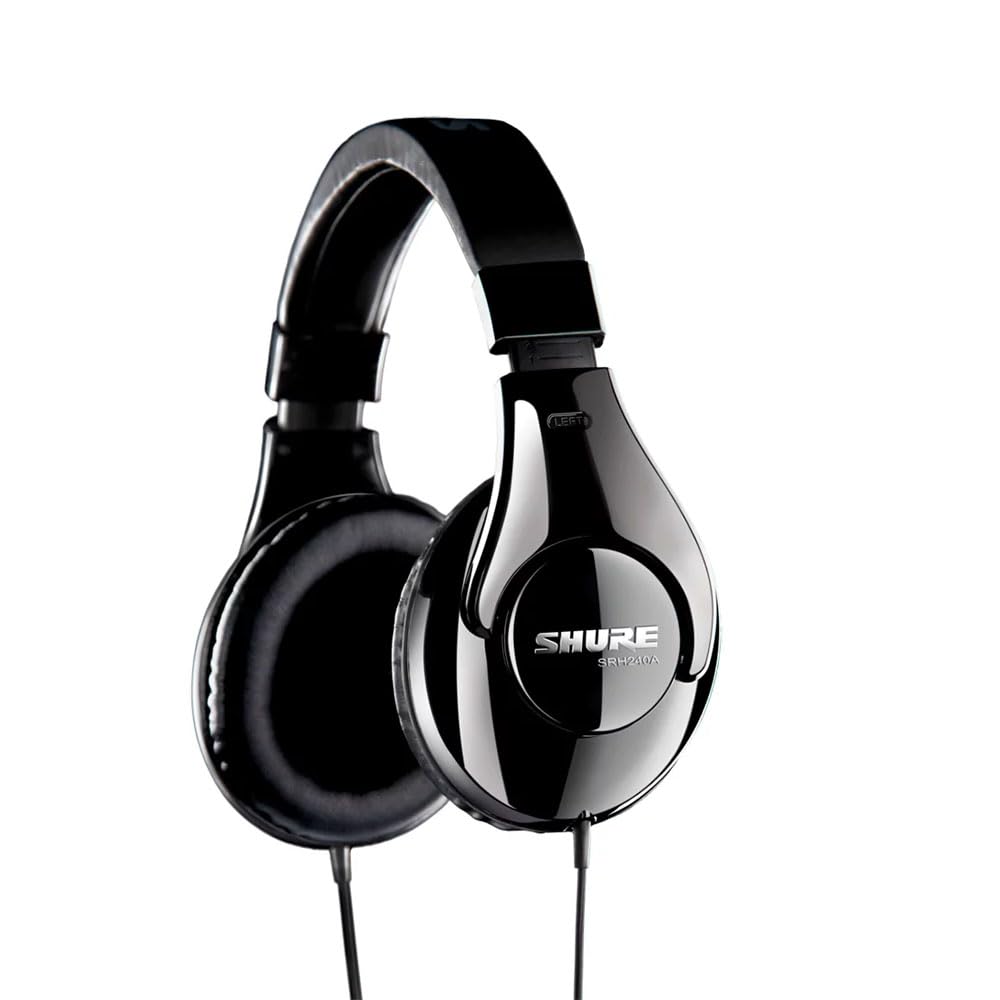
Critical review of Shure SRH240A entry-level headphones. Evaluating whether they maintain the famous Shure sound signature and determining their best applications and limitations.
Shure SRH240A Headphones Review: Entry-Level Shure Performance – But Proceed with Caution
The Shure SRH240A represents Shure’s entry point into their headphone lineup, redesigned several years ago to attract budget-conscious consumers while maintaining some connection to the legendary Shure brand heritage. The critical question is whether these sub- headphones deliver genuine Shure performance or simply bear the name without the substance.
Market Positioning and Expectations
Shure created the SRH240A as an entry-level gateway into their headphone ecosystem, targeting users who want access to the Shure name without premium pricing. However, this positioning raises important questions about whether the SRH240A provides a genuine taste of Shure’s renowned sound signature.
The redesign several years ago attempted to improve upon the original model’s shortcomings while maintaining aggressive pricing. Understanding these changes is crucial for setting appropriate expectations for potential buyers.
Build Quality and Design Analysis
Construction and Materials
The SRH240A demonstrates adequate build quality for its price point, though clearly showing the compromises necessary to achieve sub- pricing. The predominantly plastic construction provides basic durability while keeping manufacturing costs controlled.
Attention to detail varies throughout the design, with some elements showing thoughtful engineering while others reflect the budget constraints. The headband adjustment mechanism operates smoothly, though long-term durability may be questionable under heavy use.
Comfort and Wearability
Extended wearing comfort proves acceptable for shorter listening sessions but may become problematic during extended use. The ear pad design and clamping force create a reasonable compromise between comfort and acoustic seal, though users with larger ears may find the fit restrictive.
The closed-back design provides reasonable isolation for the price point, making these headphones suitable for use in moderately noisy environments where external sound intrusion might compromise listening.
Frequency Response Analysis
Deviation from Reference Standards
Analysis of the sine sweep response reveals significant deviation from flat frequency response, showing what can be described as a “rolling deviation” across the frequency spectrum. This characteristic coloration raises questions about the headphones’ suitability for different applications.
Low-frequency performance shows emphasis that may appeal to casual listeners but could mislead critical listening applications. The bass response extends reasonably well but lacks the control and accuracy expected from professional monitoring tools.
Midrange characteristics demonstrate noticeable coloration that affects vocal and instrumental reproduction. While this may create an appealing sound for some listeners, it compromises accuracy for critical applications.
High-frequency response shows irregularities that can affect timbre and detail retrieval, particularly important for evaluating recording quality and production techniques.
Application Suitability Analysis
Critical Listening Applications
For professional critical listening, the SRH240A’s frequency response limitations become problematic. The significant coloration makes it difficult to make accurate assessments of recording balance, tonal characteristics, and production quality.
Mixing and mastering applications are not well-served by the SRH240A’s colored response, as decisions made with these headphones may not translate well to other playback systems.
Casual Listening Performance
Recreational music listening may benefit from the SRH240A’s colored response, depending on individual preferences and musical genre choices. The frequency response characteristics may actually enhance certain types of popular music.
Podcast and spoken content reproduction proves adequate for casual consumption, though the midrange coloration may affect speech intelligibility in some cases.
Gaming Applications
Gaming performance varies significantly depending on game types and individual preferences. The frequency response may enhance certain gaming experiences while detracting from others where accurate audio cues are important.
Communication applications like voice chat and video conferencing prove suitable for casual use, though professional applications might benefit from more accurate alternatives.
Shure Sound Signature Assessment
Brand Heritage Connection
The crucial question for potential buyers is whether the SRH240A provides a legitimate taste of Shure’s renowned sound signature. Unfortunately, the frequency response characteristics suggest these headphones exist as a separate entity rather than a scaled-down version of Shure’s professional offerings.
Professional Shure headphones are known for accuracy, build quality, and reliability – characteristics that are necessarily compromised at the SRH240A’s price point. Users seeking to “step up” to higher-end Shure models may find the transition jarring rather than natural.
Value Proposition Concerns
The SRH240A’s positioning as an entry to the Shure ecosystem may actually mislead potential buyers about what to expect from the brand’s higher-end offerings. The significant differences in sound signature and build quality create discontinuity within the product line.
Competitive Analysis
Sub- Market Competition
In the competitive sub- headphone market, the SRH240A faces strong competition from alternatives that may offer better value propositions. Several competitors provide more neutral frequency responses or superior build quality at similar price points.
Brand premium associated with the Shure name may not justify the performance compromises when compared to lesser-known brands offering superior technical performance.
Alternative Recommendations
Users seeking accurate monitoring at budget prices might find better value in alternatives from manufacturers focusing on accuracy rather than brand recognition.
For casual listening applications, competitors may offer more engaging sound signatures without the frequency response irregularities that characterize the SRH240A.
Specific Use Case Recommendations
Recording and Production
Recording applications are not well-served by the SRH240A due to frequency response limitations that can mislead recording and mixing decisions. Professional or semi-professional users should consider alternatives with more accurate reproduction.
Content Creation
Content creators might find the SRH240A adequate for basic monitoring applications where ultimate accuracy is less critical than basic functionality and low cost.
Educational Applications
Students and beginners might appreciate the low entry cost, though the colored sound signature could potentially hinder development of critical listening skills.
Long-Term Ownership Considerations
Durability Expectations
The build quality compromises necessary to achieve the target price point suggest that long-term durability may be limited compared to Shure’s professional offerings. Users should plan accordingly for potential replacement needs.
Upgrade Path Concerns
The significant differences between the SRH240A and higher-end Shure models may create confusion for users attempting to upgrade within the brand lineup.
Critical Assessment and Warnings
Misleading Brand Expectations
The primary concern with the SRH240A is that it may mislead potential buyers about Shure’s actual sound signature and build quality standards. The headphones essentially exist as a separate product that happens to bear the Shure name.
Professional applications requiring accuracy should avoid the SRH240A despite the brand heritage, as the performance compromises make these headphones unsuitable for serious audio work.
Appropriate Applications
The SRH240A finds its best use in casual applications where the brand name provides psychological satisfaction and the frequency response coloration doesn’t compromise the intended use case.
Final Recommendation with Cautions
The Shure SRH240A can serve adequately in casual listening applications where ultimate accuracy is not required and budget constraints are paramount. However, potential buyers should proceed with clear understanding of the limitations and compromises.
Critical listening, recording, or professional applications should look elsewhere for tools that provide the accuracy and reliability typically associated with the Shure name. The SRH240A simply cannot deliver professional performance at its price point.
For casual users seeking a decent-sounding headphone with brand recognition, the SRH240A may suffice. However, alternatives offering better technical performance without the brand premium deserve serious consideration.
The most important advice is to manage expectations carefully – these are budget headphones that happen to carry the Shure name, not scaled-down professional tools. Understanding this distinction is crucial for making an informed purchase decision.
Related posts:
 Shure SRH1840 Open-Back Headphones Review: Professional Mastering Excellence
 Shure SRH550DJ Headphones Review: Affordable DJ Monitoring with Trade-offs
 Shure SRH840A Headphones Review: Content Creator Monitoring Evaluated
 Mackie MC250 Studio Headphones Review: Entry-Level Monitoring Tested
 Status Audio CB-1 Headphones Review: Professional Studio Performance at an Accessible Price
 Pioneer DJ HDJ-CUE1 Review: Affordable Entry-Level DJ Headphones with Customization Options
 Superlux HD681 Headphones Review: Are These Semi-Open Headphones Still Worth It in 2025?
 OneOdio Monitor 60 Review: Surprising Performance from Closed-Back Studio Headphones