

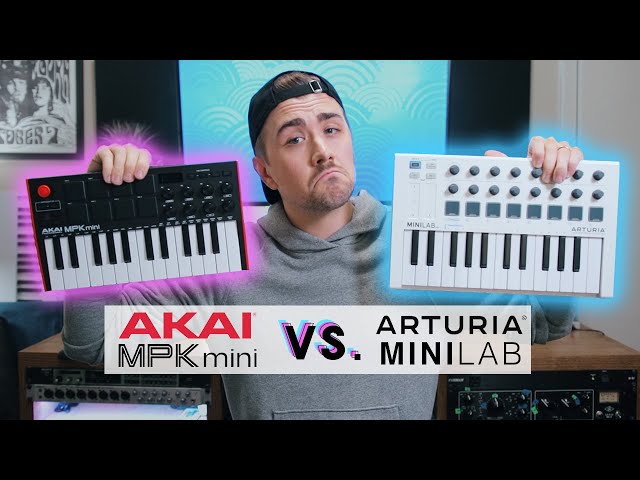
In-depth comparison of Akai MPK Mini Mark III and Arturia MiniLab Mark II. Expert analysis of keybeds, drum pads, build quality, portability, and features to help you choose the perfect budget MIDI keyboard for your needs.
Akai MPK Mini Mk3 vs. Arturia MiniLab Mk2: Complete Comparison Guide for Your Next MIDI Keyboard
Introduction: Battle of the Budget MIDI Kings
The Akai MPK Mini Mark III and Arturia MiniLab Mark II represent two of the most popular MIDI keyboards available today. With the recent release of the MPK Mini Mark III—the next generation of Akai’s beloved budget controller—many producers face a crucial decision: which keyboard deserves a place in their studio?
This comprehensive comparison examines every significant difference between these controllers to help you determine which keyboard best suits your specific needs and workflow.
Shared Features: Common Ground
Before diving into differences, let’s establish what these keyboards share:
Core Specifications
- 25 mini keys with velocity sensitivity
- Eight drum pads with pad banking for 16 total programmable pads
- Endless encoder rotary knobs for parameter control
- Octave controls for extended range
- Sustain pedal jack on rear panel
- USB bus-powered operation
These commonalities establish both keyboards as serious contenders in the budget MIDI category. However, the differences determine which controller best matches individual requirements.
Keybed Comparison: The Most Important Factor
Why Keybeds Matter
MIDI keyboards exist primarily for playing keys. While controllers serve many functions in modern production, keybed quality fundamentally determines playing experience and musical expression capability.
Akai MPK Mini Mark III Keybed
Akai invested significant resources improving the Mark III keybed, addressing major complaints about the Mark II. The result—called the Gen 2 Enhanced Dynamic Keybed—delivers:
- Solid feel with improved structural integrity
- Excellent key travel for mini keys
- Accurate dynamics with responsive velocity sensitivity
- Reliable performance addressing previous durability concerns
The Gen 2 keybed represents a massive improvement over its predecessor, bringing the MPK Mini’s playing experience to competitive standards.
Arturia MiniLab Mark II Keybed
Despite the MPK Mini’s improvements, the Arturia MiniLab Mark II keybed remains exceptional and arguably superior. Key advantages include:
- Outstanding dynamics with perfectly dialed-in velocity response
- Superior key travel providing excellent tactile feedback
- Premium feel that belies the keyboard’s budget price
- Slightly larger keys — both wider and longer than MPK Mini keys
- Exceptional ease of play enabling extended playing sessions
The size difference, while appearing subtle, becomes immediately apparent during use. The additional key dimensions enhance playing comfort and accuracy significantly.
Keybed Quality Recognition
Arturia’s confidence in this keybed speaks volumes—they incorporated the identical keybed into their KeyStep Pro, a serious piece of equipment retailing around $400. This reuse of MiniLab components in premium products demonstrates the keybed’s professional-grade quality.
Verdict: Keybed Winner
If keybed quality is your top priority, choose the Arturia MiniLab Mark II without hesitation. The playing experience simply outclasses budget competition, including the improved MPK Mini Mark III.
Drum Pads: MPC Legacy vs. Compact Design
Akai MPK Mini Mark III Drum Pads
Akai’s storied history with the MPC series established their reputation for exceptional drum pads. That legacy continues in the MPK Mini Mark III:
- Large MPC-style pads with familiar layout
- Two rows of four creating intuitive playing surface
- Superior size — notably larger than MiniLab pads
- Excellent velocity response capturing dynamic nuance
- Best-in-class at this price point
Layout Advantages
The 2×4 pad layout provides genuine functional benefits:
- Thumb incorporation in finger drumming techniques
- Multi-pad combinations easier to execute
- Intuitive pattern programming with familiar grid layout
Slight Compromise
The Mark III pads exhibit more stiffness than traditional MPC pads on professional-grade equipment. While softer pads might feel preferable, the velocity response remains so accurate that this stiffness rarely impacts performance. Given the price differential between the MPK Mini and professional MPC controllers, this minor compromise seems entirely reasonable.
Arturia MiniLab Mark II Drum Pads
The MiniLab’s pads deliver solid performance with distinctive characteristics:
- Compact single-row layout with eight pads
- Nice texture and feel suitable for pad triggering
- RGB backlighting with customizable colors
- Adequate velocity sensitivity
The pads perform their function well, and the RGB lighting adds helpful visual feedback during performance. However, the smaller size and single-row layout change the finger drumming experience compared to the MPK Mini’s larger pad surface.
Verdict: Drum Pad Winner
If drum pads represent an important feature, the Akai MPK Mini Mark III wins decisively. The size, layout, and feel of the pads simply can’t be matched at this price point.
Build Quality and Portability: Premium vs. Portable
Akai MPK Mini Mark III Build
The Mark III’s build quality improved substantially over the Mark II:
- High-grade plastic construction throughout
- Sturdy feel without flimsiness
- Compact dimensions for maximum portability
- Lightweight without feeling cheap
The plastic construction, while not premium, feels appropriate for the price point and enhances portability.
Arturia MiniLab Mark II Build
The MiniLab takes a noticeably different approach:
- Metal or aluminum base plate providing substantial weight
- Premium feel exceeding expectations for budget controllers
- Superior perceived quality in hand
- Larger footprint than MPK Mini
The MiniLab’s construction feels more like equipment you’d find at significantly higher price points. The weight and materials inspire confidence in longevity and reliability.
Size and Portability Comparison
The size difference between these controllers proves significant. The MPK Mini’s compact dimensions make it genuinely portable—easily fitting into backpacks and laptop bags for mobile production. The MiniLab, while not enormous, occupies noticeably more space and weighs substantially more.
Verdict: Split Decision
Build Quality Winner: Arturia MiniLab Mark II — The premium materials and construction provide superior durability and perceived value.
Portability Winner: Akai MPK Mini Mark III — The smaller footprint and lighter weight make it the clear choice for mobile producers.
Pitch and Modulation: Different Approaches
MPK Mini: Four-Way Joystick
Akai’s omnidirectional joystick combines pitch bend and modulation into a single compact control. While this space-saving solution works adequately, it requires adjustment:
- Compact design saves surface space
- Dual-axis control can lead to accidental triggering
- Adequate performance after acclimation period
- Somewhat gimmicky feel compared to traditional controls
The joystick functions fine once you adapt to its quirks. Accidental modulation while pitch bending (or vice versa) occurs occasionally but becomes less frequent with experience.
MiniLab: Touch Strips
The MiniLab employs touch-sensitive strips for pitch bend and modulation:
- Separate controls prevent accidental cross-triggering
- Smooth response to finger position
- Less tactile than physical wheels or joysticks
- Adequate but not inspiring
The touch strips work well enough without excelling. Some users miss the tactile feedback of traditional wheels, though others appreciate the modern, clean aesthetic.
Verdict: No Clear Winner
Both approaches represent compromises compared to traditional pitch/mod wheels found on larger keyboards. Neither solution significantly outperforms the other—both work adequately without inspiring enthusiasm.
Rotary Knobs: Quantity and Quality
Knob Count
- Arturia MiniLab Mark II: 16 endless encoder knobs
- Akai MPK Mini Mark III: 8 endless encoder knobs
The additional eight knobs on the MiniLab provide obvious advantages for complex parameter mapping and mixing operations.
Knob Quality
Both keyboards feature endless encoders—the superior choice for MIDI control. However, subtle quality differences exist:
The MiniLab knobs feature a rubberized matte finish providing excellent grip and premium feel. The larger quantity of knobs and slightly superior tactile quality give the MiniLab an edge in this category.
Verdict: Rotary Knob Winner
Arturia MiniLab Mark II — Double the knobs with marginally better feel equals clear superiority for users requiring extensive parameter control.
Exclusive Features: MPK Mini Advantages
The MPK Mini Mark III includes several features absent from the MiniLab:
Built-In Note Repeat
The dedicated note repeat function accelerates drum programming significantly. Rapid hi-hat patterns, rolls, and rhythmic elements become trivial to input. This feature alone can dramatically speed up beat-making workflow.
Professional Arpeggiator
The MPK Mini’s arpeggiator remains one of the best available in budget keyboards, offering:
- Extensive customization options
- Multiple pattern types
- Intuitive control interface
OLED Display
The small screen provides real-time visual feedback for:
- Velocity values
- Parameter adjustments
- Arpeggiator settings
- Current control mappings
While not revolutionary, the display grows increasingly useful with extended use, providing convenient at-a-glance information without referencing computer screens.
Included Software: Value-Added Bundles
MPK Mini Mark III Bundle
The primary highlight is MPC Beats—legitimate beat-making software based on Akai’s professional MPC workflow. While available as free download, its inclusion provides value for users new to the ecosystem. Additional piano sounds (Mini Grand, Velvet) and the Hybrid 3 synthesizer round out the package.
MiniLab Mark II Bundle
The MiniLab includes Analog Lab Lite—an introductory version of Arturia’s excellent vintage keyboard and synthesizer collection. This software provides access to preset sounds from Arturia’s meticulously modeled classic instruments.
Verdict: Software Winner
Arturia MiniLab Mark II — Analog Lab Lite offers superior long-term value, providing high-quality sounds that producers will actually use in productions. Arturia’s software synthesizers and vintage keys enjoy excellent reputation and see regular use by professionals.
Integration and Workflow Considerations
Arturia Ecosystem
The MiniLab integrates seamlessly with Arturia’s extensive software catalog. For producers interested in Arturia’s vintage keyboards, synthesizers, or plugins, the MiniLab provides optimized control and streamlined workflow.
Akai Ecosystem
The MPK Mini works excellently with MPC-style workflows and integrates well with Akai’s production software. Beat makers already invested in Akai products will find familiar functionality.
Price Comparison
Both keyboards typically retail in similar price ranges, with fluctuations based on sales and promotions. At comparable prices, the decision hinges on feature priorities rather than budget constraints.
Final Recommendations: Which Should You Choose?
Choose Arturia MiniLab Mark II If:
- Keybed quality is your top priority — The superior playing experience justifies the choice
- Build quality matters — You value premium materials and construction
- You use or plan to use Arturia software — Integration provides significant workflow benefits
- Extensive parameter control is essential — The 16 knobs enable complex mapping
- You’re primarily a keys player — The better keybed makes extended playing more enjoyable
Choose Akai MPK Mini Mark III If:
- Portability is crucial — The compact size enables genuine mobile production
- Drum pads are essential — Superior pad size and layout benefit beat makers
- You want an all-around performer — The jack-of-all-trades approach serves diverse needs
- Note repeat and arpeggiator features matter — These production tools accelerate workflow
- You work with Akai ecosystem — Integration with MPC Beats and Akai workflow benefits
Conclusion: Two Excellent Options
Both the Akai MPK Mini Mark III and Arturia MiniLab Mark II represent outstanding value in budget MIDI keyboards. Neither is objectively “better”—they excel in different areas.
The MiniLab targets players prioritizing keybed quality and build, especially those working within Arturia’s software ecosystem. The MPK Mini serves beat makers and producers seeking portability, excellent drum pads, and versatile all-around performance.
Your specific workflow, musical focus, and feature priorities should guide the decision. Both controllers will serve you well; the question is which one serves you better based on how you make music.
Related posts:
 Arturia MiniLab 3 vs. Akai MPK Mini Mk3: Expert Comparison of the Best Entry-Level MIDI Keyboards
 Akai MPK Mini Plus vs. MPK Mini Play vs. MPK Mini Mk3: Complete Comparison Guide
 Akai MPK Mini Mk3 Review: Is This Still the Best MIDI Keyboard in 2025?
 Jamstik Studio vs. Jammy MIDI Guitar: Complete Comparison Guide to Choosing Your Perfect MIDI Guitar
 Best MIDI Controllers and Affordable MIDI Keyboards for Music Production in 2025
 Arturia KeyStep Pro Review: Building the Ultimate Hybrid MIDI Controller Setup for Modern Production
 Akai Professional
 Akai Force Standalone Sampler/Sequencer Review: The Ultimate Performance Workstation