

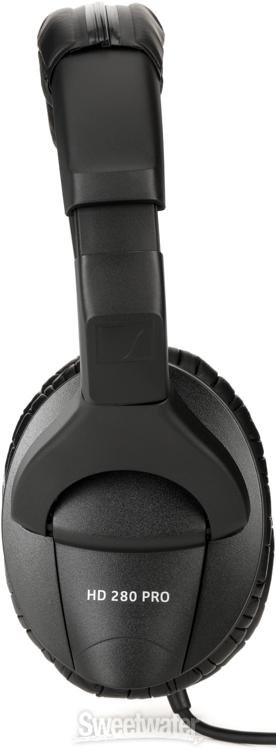
Comprehensive review of the legendary Sennheiser HD 280 Pro studio headphones. Detailed frequency analysis, audio tests, and professional evaluation for recording, monitoring, and mixing applications.
Sennheiser HD 280 Pro Review: Studio Standard Headphones Tested in 2025
Walk into professional recording studios around the world and you’ll likely encounter Sennheiser HD 280 Pro headphones. These closed-back monitors have earned legendary status as a staple for tracking, recording, and monitoring applications. But does this reputation remain justified in today’s competitive marketplace?
Comprehensive Audio Testing Methodology
Evaluating the HD 280 Pro requires moving beyond subjective impressions to objective measurement. Using binaural microphone recording techniques combined with frequency analysis provides quantifiable data about how these headphones reproduce audio across different content types.
The testing protocol encompasses sine wave sweeps from 20Hz to 20kHz, musical content spanning multiple genres, spoken word material, and game audio. This comprehensive approach reveals not only frequency response characteristics but also how the headphones handle complex, real-world content.
Frequency Response Analysis: Sine Wave Testing
Initial sine wave sweep testing on both linear and logarithmic scales reveals the HD 280 Pro’s fundamental frequency characteristics. The linear analysis suggests modest roll-off beginning in the higher frequencies, though the logarithmic view—which better represents human hearing perception—provides more nuanced information.
Logarithmic analysis exposes some missing frequencies just above 1kHz, along with noticeable roll-off after approximately 10kHz. This high-frequency attenuation proved more pronounced than initially detected during casual listening, though it remains within acceptable parameters for professional monitoring applications. The lower frequencies demonstrate accurate reproduction without excessive emphasis or thinness.
These measurements suggest that while the HD 280 Pro doesn’t achieve perfectly flat response, the deviations remain predictable and manageable for experienced users who learn their characteristics.
Musical Content Performance
Sine wave testing provides valuable baseline data, but music reproduction introduces complexity that better represents real-world usage. Multiple simultaneous frequencies interacting within the drivers can reveal response characteristics not apparent in single-tone testing.
Linear comparison of musical content confirms the roll-off above 10kHz observed in sine wave analysis. Lower frequencies appear accurate, though the logarithmic view reveals more interesting details. An intriguing boost appears in the high presence frequencies around 8-10kHz, followed by sharper roll-off above that range. This explains the perceived clarity in certain frequency regions despite overall high-frequency attenuation.
Additionally, subtle enhanced energy appears in the sub-bass region and around 200Hz. These minor deviations contribute to the HD 280 Pro’s character without dramatically altering tonal balance. For music monitoring, mixing, and casual listening, the frequency response remains acceptable, with the primary consideration being the softened extreme highs.
Users accustomed to brighter headphones may initially perceive the HD 280 Pro as slightly dark or muted in the treble region. However, this characteristic can actually reduce listening fatigue during extended sessions while still providing adequate detail for professional work.
Spoken Word Reproduction
Voice monitoring represents a critical application for studio headphones, whether tracking vocals, producing podcasts, or evaluating voice-over recordings. The HD 280 Pro handles spoken word material competently, with some notable characteristics worth understanding.
Linear analysis of speech reproduction shows accurate low-end response with the presence boost around 8-9kHz and expected high-frequency roll-off. The logarithmic comparison confirms these observations while revealing that the roll-off proves less pronounced for speech-range frequencies than for full-spectrum music.
The presence boost manifests as enhanced clarity and articulation in voices—not necessarily undesirable for monitoring applications where intelligibility takes priority. The HD 280 Pro doesn’t introduce the scooped midrange or excessive sibilance common in consumer headphones, making them suitable for critical voice work across various production contexts.
Podcasters, voice actors, and vocal engineers can confidently use the HD 280 Pro for monitoring, understanding that the slight presence enhancement may require minor compensation when making EQ decisions.
Gaming Audio Capabilities
While studio monitoring constitutes the primary design intent, many users seek headphones that perform competently across multiple applications including gaming. The HD 280 Pro proves surprisingly capable for gaming despite not targeting this market.
Spatial representation registers as quite good, with reasonable positioning of environmental sounds and directional cues. The absence of overemphasized bass prevents muddiness that can obscure important audio information in competitive gaming scenarios. Footsteps, environmental ambience, and positional audio all come through with adequate clarity and separation.
That said, these aren’t gaming headphones and shouldn’t be compared directly to designs optimized for that application. For users wanting one versatile set of headphones that handles both studio work and casual gaming, the HD 280 Pro represents a reasonable compromise rather than an ideal gaming solution.
Build Quality and Durability
The HD 280 Pro’s legendary studio presence stems partly from robust construction that withstands years of professional use. The predominantly plastic construction incorporates metal reinforcement in the headband, providing necessary strength without excessive weight.
A particularly practical feature is the ability to fold the ear cups inward, creating a compact package for storage or transport. This proves valuable for mobile recording applications or users with limited studio space.
One controversial design decision is the fixed, non-detachable cable. While many users prefer detachable cables for easier replacement, Sennheiser’s choice here reflects confidence in cable durability and connection reliability. The cable does feature substantial weight and thickness—noticeably heavier than many competing designs—which some users may find cumbersome.
The ear cups provide swivel adjustment in one direction with considerable extension range, accommodating diverse head sizes and shapes. Padding features pleather material on both the headband and ear pads, offering reasonable comfort though with the warmth accumulation typical of synthetic materials during extended wear.
Clamping force strikes an effective balance—firm enough for excellent seal and isolation without creating fatigue or discomfort. This seal proves essential for the tracking applications where the HD 280 Pro excels, preventing headphone bleed into sensitive microphones.
Technical Specifications
The HD 280 Pro features 64-ohm impedance, requiring slightly more power than typical consumer headphones but remaining compatible with smartphones, tablets, and certainly any audio interface. Users may need to increase volume slightly compared to lower-impedance designs, but power requirements remain modest by professional standards.
As closed-back headphones, the HD 280 Pro provides substantial isolation—crucial for tracking applications. The combination of closed design and effective seal creates an environment where performers can monitor clearly without sound leaking into microphones positioned nearby.
Target Users and Applications
Sennheiser identifies two primary audiences for the HD 280 Pro. Professional studios employ them extensively for tracking—recording vocalists, instrumentalists, and drummers who require clear monitoring without generating microphone bleed. The excellent isolation and durable construction prove ideal for this demanding application. In this context, they compete directly with Sony’s legendary MDR-7506 headphones as industry standards.
Home and project studios typically require headphones for broader applications beyond tracking. Users may want headphones suitable for recording, mixing, and general content creation. Based on comprehensive testing, the HD 280 Pro demonstrates sufficient accuracy for these varied applications.
Like any monitoring tool, users must learn the HD 280 Pro’s characteristics—understanding which frequencies are over or under-represented relative to flat response. However, the deviations remain manageable rather than extreme, allowing experienced users to compensate mentally when making critical decisions.
For mixing music or monitoring podcast production, the HD 280 Pro performs adequately in its price range. The accurate midrange and controlled bass response provide a solid foundation, with the primary adaptation being awareness of the softened extreme highs.
Value Proposition
The HD 280 Pro has existed for years, with the current version representing the second iteration of this design. Despite their longevity, they remain competitive based on frequency response accuracy, build quality, and pricing.
For creators and musicians seeking reliable, accurate headphones for recording and monitoring without extreme budget constraints, the HD 280 Pro deserves recommendation. They represent known quantities with established reputations that remove much guesswork from the purchasing decision.
Users specifically needing the latest features, lightest weight, or most innovative designs might explore newer alternatives. However, for professionals valuing proven performance and long-term reliability, the HD 280 Pro’s continuation in studio racks worldwide speaks volumes about their enduring relevance.
Conclusion
The Sennheiser HD 280 Pro maintains its position as a studio standard through consistent performance rather than revolutionary innovation. These headphones accomplish their intended purpose reliably—providing accurate monitoring with excellent isolation in durable packages that withstand professional use.
Understanding their frequency response characteristics allows users to make informed decisions about suitability for specific applications. For tracking, the HD 280 Pro remains an excellent choice. For mixing and monitoring, they prove capable tools that serve well when users adapt to their particular sonic signature.
In an industry where new products constantly promise incremental improvements, the HD 280 Pro’s decades-long studio presence demonstrates that fundamentally sound engineering withstands market trends. For users seeking headphones they can trust for important work without chasing the latest developments, these represent wise, reliable investments.
Related posts:
 Mackie MC250 Studio Headphones Review: Entry-Level Monitoring Tested
 Sennheiser HD600 Headphones Review: Do They Still Hold Their Legendary Status in 2025?
 Audio-Technica ATH-M50X Review: The Studio Standard That Lives Up to the Hype
 Sennheiser HD200 Pro Headphones: Detailed Review and Audio Tests
 Sony MDR-7506 Review: The Studio Standard Since 1991 – Does It Still Deliver?
 Sony MDR-M1 Professional Headphone Review: A New Closed Back Studio Standard
 Beyerdynamic DT 700 Pro X Review: Premium Studio Headphones with Unique Character
 Audio-Technica ATH-M20x Review: Your First Studio Headphones at an Affordable