

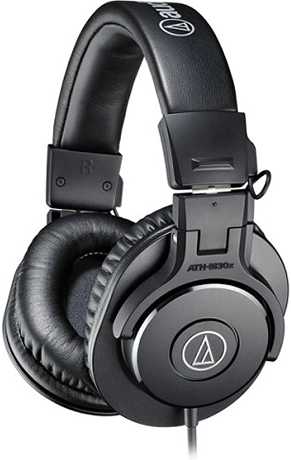
Detailed review of the Audio-Technica ATH-M30x closed-back studio headphones. Honest assessment of frequency response, build quality, and suitability for mixing, tracking, and content creation on a budget.
Audio-Technica ATH-M30x Review: Budget Studio Headphones with Significant Compromises
Introduction
Audio-Technica’s M-series headphones span a wide range of price points and performance levels. The ATH-M30x occupies the entry tier, promising studio-quality monitoring at an accessible price. However, budget constraints necessitate compromises, and understanding these limitations proves essential for making informed purchasing decisions.
Frequency Response Reality
Sine Wave Analysis
Comprehensive frequency testing reveals the M30x’s sonic character with scientific precision. The logarithmic analysis shows a significant dip around 5kHz accompanied by substantial boost at 10kHz. The linear analysis provides additional detail, confirming these deviations and revealing roll-off at the frequency extremes.
This frequency response pattern creates a pronounced “scooped” sound signature—reduced midrange energy combined with elevated high frequencies. While some listeners enjoy this character for casual use, it presents challenges for critical listening applications.
The sub-bass frequencies show slight emphasis beyond the headphones’ official response range, though this occurs with considerable roll-off that limits true low-end extension.
Music Performance
Music playback reveals how the M30x’s frequency response affects real-world content. The scooped midrange becomes immediately apparent, creating a hollow quality that places vocals and midrange instruments at a disadvantage relative to bass and treble content.
The bass emphasis adds punch and weight that some listeners find enjoyable, particularly for bass-heavy genres. However, this coloration prevents accurate assessment of low-frequency balance during mixing applications.
The elevated highs add superficial detail and “air,” but the 5kHz dip simultaneously robs the sound of presence and clarity. This contradictory response creates confusion—the headphones sound detailed in some ways yet veiled in others.
Both linear and logarithmic comparisons confirm that the M30x significantly colors source material. Engineers making critical decisions on these headphones risk creating mixes that sound unbalanced on more neutral monitoring systems.
Vocal Analysis
Vocal reproduction suffers particularly from the M30x’s frequency response. The 5kHz dip removes essential presence frequencies that define vocal intelligibility and intimacy. Meanwhile, the 10kHz boost adds sibilance that isn’t present in source recordings.
Male and female vocals both lose definition and natural character, though the specific effects vary. The overall result sounds artificial and processed, making these headphones questionable choices for voice-over editing, podcast production, or vocal mixing.
Spoken Word Performance
Spoken word content reveals practical limitations for broadcast and podcast applications. The 5kHz deficiency reduces speech intelligibility, while the 10kHz elevation adds distracting sibilance. The additional under-emphasis around 1kHz creates a hollow quality that distances the listener from the speaker.
Some listeners may find this tuning pleasant for casual podcast listening, but content creators should avoid using the M30x for editing and mastering decisions. The colorations will lead to processing choices that don’t translate well to audience playback systems.
Build Quality Assessment
The M30x construction reflects its budget positioning. The predominantly plastic materials keep weight low but inspire less confidence than more expensive Audio-Technica models.
A metal reinforcement band runs through the headband, providing basic structural integrity. The smooth adjustment mechanism lacks the stepped detents found on pricier models, potentially allowing unwanted position changes during use.
The exposed wires running to each ear cup create vulnerability—snagging could damage the headphones and require repair.
The permanently attached cable represents a significant limitation. Cable failure means either DIY repair involving soldering or complete headphone replacement. The cable itself offers decent quality, but the lack of replaceability reduces the product’s serviceable lifespan.
The ear pads feel firm and shallow, limiting comfort during extended sessions. The pads also generate significant heat buildup, making the headphones uncomfortable during long editing or mixing sessions. The shallow depth may cause larger ears to contact the drivers, further reducing comfort.
The headband padding provides adequate cushioning for the M30x’s light weight, though it’s nothing special. The materials throughout feel functional but not premium.
Comfort and Ergonomics
Comfort represents a significant weakness for the M30x. The firm, shallow ear pads generate heat quickly and provide minimal cushioning. Users with larger ears will find the shallow cups problematic, while everyone will notice warmth during extended wear.
The light weight partially compensates for the pad issues, preventing the headphones from feeling oppressive. However, the overall comfort level falls below competitors at similar price points.
The M30x does fold for compact transport, and the light weight makes them portable. However, the comfort and sound quality limitations make them questionable choices for travel use.
Isolation Performance
Sound isolation disappoints relative to expectations for closed-back studio headphones. The firm pads that compromise comfort also reduce sealing effectiveness, allowing more sound leakage than competitors.
For tracking applications requiring isolation to prevent headphone bleed into microphones, the M30x performs adequately but not exceptionally. More expensive Audio-Technica models like the M40x and M50x provide superior isolation.
Soundstage and Imaging
The M30x presents a very closed-in soundstage with little sense of space or dimension. Everything sounds confined within the headphones rather than projecting into a listening environment.
This limited soundstage proves particularly problematic for mixing applications, where spatial relationships between instruments matter significantly. The M30x provides minimal information about width, depth, or placement.
Gaming performance suffers from the same limitation. The closed-in presentation prevents immersion and makes spatial awareness difficult despite the headphones not being marketed for gaming use.
Technical Specifications
The M30x employs 40mm drivers with neodymium magnets—standard for this product category. The 47-ohm impedance allows easy driving from any source without amplification requirements.
Frequency response specification lists 15Hz to 22,000Hz, though the actual response includes significant deviations throughout this range. Sensitivity measures 96dB with maximum input power of 300 milliwatts.
The voice coils use copper-clad aluminum wire—a cost-effective alternative to pure copper. Audio-Technica claims -30dB noise attenuation, though real-world performance suggests more modest isolation.
The three-meter straight cable provides adequate length for studio use, though the permanently attached design remains problematic.
At 220 grams, the M30x weighs less than most studio headphones, though this lightness comes at the cost of premium materials and substantial construction.
Use Case Analysis
Not Recommended For:
Critical Listening Applications – The significant frequency response deviations make the M30x unsuitable for mixing, mastering, or any application requiring accurate monitoring. Engineers using these headphones will make decisions that don’t translate well to other playback systems.
Podcast and Voice-Over Production – The scooped midrange and elevated highs will lead to EQ and processing choices that sound wrong on balanced monitoring systems.
Long Editing Sessions – The comfort limitations and frequency response make extended wear fatiguing both physically and audibly.
Potentially Acceptable For:
Casual Listening – Listeners who enjoy scooped, bright sound signatures may find the M30x pleasing for recreational music enjoyment, particularly with bass-heavy genres.
Tracking in a Pinch – While far from ideal, the M30x can function for basic tracking applications where isolation matters less than critical monitoring.
Portable Use – The light weight and folding design suit portable applications, though numerous competitors offer better sound and comfort at similar prices.
Value Proposition
At its typical price point, the M30x faces fierce competition from alternatives that offer better sound quality, superior comfort, or both. The permanently attached cable alone represents a liability that reduces long-term value.
Audio-Technica’s own M40x deserves serious consideration as a modest step up in price but a substantial improvement in performance. The M40x offers more neutral frequency response, better build quality, and detachable cables—all significant advantages that justify the small additional investment.
Final Verdict
The Audio-Technica ATH-M30x exists in a difficult position within the studio headphone market. The budget price point necessitates compromises that undermine the headphones’ core mission of providing accurate monitoring for audio work.
The significant frequency response colorations make the M30x unsuitable for critical listening applications. Content creators, engineers, and producers should invest slightly more in the M40x or similar alternatives that offer meaningfully better performance.
The comfort limitations further reduce the M30x’s appeal, making extended sessions uncomfortable regardless of sound quality concerns.
For recreational listening by users who specifically enjoy bright, scooped sound signatures, the M30x may provide acceptable performance. However, even casual listeners can find better-sounding and more comfortable alternatives at similar prices.
The M30x earns a cautious “not recommended” verdict for most use cases. The compromises required to hit this price point prove too severe, resulting in headphones that struggle to excel at any particular application. Prospective buyers should seriously consider spending slightly more for significantly better performance and long-term value.
Related posts:
 Audio-Technica ATH-M20x Review: Your First Studio Headphones at an Affordable
 Audio-Technica ATH-M40x Review: The Unsung Hero of Studio Headphones
 Audio-Technica ATH-AVC400 Review: The Hidden Gem for Budget-Conscious Creators
 Audio-Technica ATH-M50X Review: The Studio Standard That Lives Up to the Hype
 Behringer BH470 Studio Monitor Headphones Review: Budget-Friendly but Compromised
 Status Audio CB-1 Headphones Review: Professional Studio Performance at an Accessible Price
 Audio-Technica ATH-M70x Review: Premium Performance with Critical Limitations
 One Audio Monitor 80 Headphones Review: Did OneOdio Really Make These Open-Back Budget Champions?