

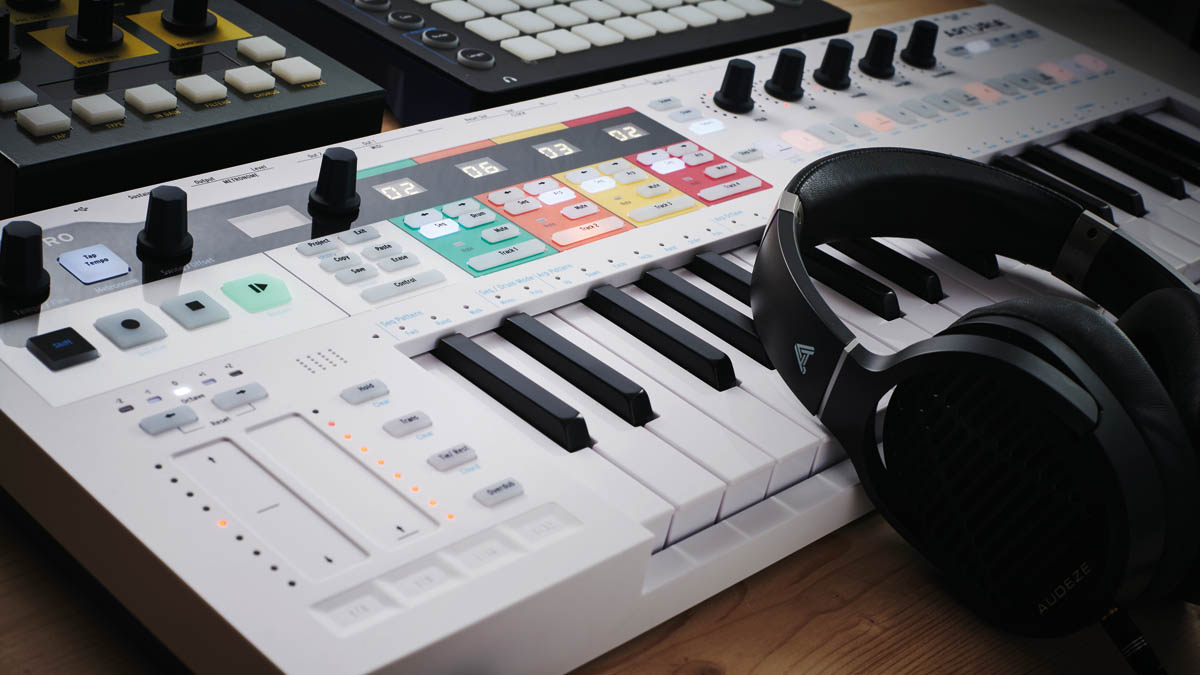
Comprehensive guide to the best MIDI controllers across multiple price points. Expert recommendations from budget-friendly portable options to professional-grade keyboards for serious producers and musicians.
Best MIDI Controllers and Affordable MIDI Keyboards for Music Production in 2025
Introduction: Essential Tools for Modern Music Production
MIDI controllers represent the most frequently used tools in contemporary music production workflows. Whether for songwriting, beat making, or full production, MIDI keyboards bridge the gap between musical ideas and digital realization. These controllers connect to computers via USB, enabling triggering and control of software instruments within digital audio workstations.
This comprehensive guide explores the best MIDI controller options across various price points, helping you find the perfect keyboard for your specific needs and budget.
Budget Champion: Akai LPK25 ($55)
The Entry Point
The LPK25 represents an ideal starting point for producers taking their first steps into MIDI control. This ultra-affordable keyboard delivers surprising capability at an price that won’t strain any budget.
Key Features
- 25 mini keys providing two-octave range
- Extremely lightweight construction
- Highly portable — fits easily in backpacks
- Built-in sustain function
- Octave controls for range extension
- Built-in arpeggiator for creative patterns
- USB bus-powered requiring no external power supply
Ideal Users
The LPK25 perfectly serves:
- Absolute beginners exploring music production
- Students on tight budgets
- Mobile producers requiring ultra-portable control
- Supplementary controllers for existing setups
- Laptop producers working in compact spaces
Limitations to Consider
At this price point, compromises exist. Most notably, the absence of drum pads limits beat-making workflow. While you can trigger drum sounds using keyboard keys, the experience lacks the expressiveness and artistry of dedicated drum pads. For producers prioritizing keyboard melodies and chord progressions over beat programming, this limitation proves negligible.
Value Assessment
At approximately $55, you genuinely “can’t go wrong” with the LPK25. The combination of portability, essential features, and incredibly low price makes this a risk-free entry into MIDI control.
Budget with Pads: Akai MPK Mini ($99-119)
The Popular Choice
The Akai MPK Mini (particularly the current Mark III) has established itself as perhaps the most popular budget MIDI keyboard. This controller delivers substantially more functionality than the LPK25 while maintaining affordability and portability.
Enhanced Features
- 25 mini keys matching LPK25 range
- Eight drum pads with MPC-style feel and layout
- Eight programmable knobs for parameter control
- Pad banking (16 total pads on Mark III)
- Built-in arpeggiator with extensive customization
- Note repeat for drum programming
- Portable design suitable for mobile production
The Drum Pad Advantage
The inclusion of quality drum pads transforms workflow for beat makers. The MPC-heritage pads deliver excellent velocity sensitivity and comfortable playing surface, enabling expressive finger drumming and sample triggering unavailable on pad-less controllers.
Additional Knobs
The programmable rotary knobs provide hands-on control for:
- Filter cutoff and resonance on software synthesizers
- Mix parameters within your DAW
- Effect parameters for real-time adjustment
- Any MIDI-mappable parameter in your software
Ideal Users
The MPK Mini serves:
- Producers wanting comprehensive features at budget price
- Beat makers requiring quality drum pads
- Mobile producers maintaining portability priority
- Users upgrading from pad-less controllers
- Anyone seeking industry-standard budget controller
Value Assessment
At the approximately $100-120 price point, the MPK Mini represents the strongest value in portable MIDI keyboards. The feature set rivals controllers costing significantly more while maintaining compact form factor.
Professional Portable: M-Audio Code 25 ($250)
Stepping Up
The M-Audio Code 25 represents the next tier—professional-grade MIDI control in portable package. After a week of studio use, the quality and capability justify every dollar of the premium over budget options.
Premium Features
- 25 full-sized, semi-weighted keys (not mini keys)
- 16 fully programmable drum pads with excellent sensitivity
- Dedicated pitch wheel
- Dedicated modulation wheel
- Multiple programmable knobs and faders
- X/Y pad with extensive functionality
- Professional build quality
Full-Sized Keys Advantage
The transition from mini keys to full-sized keys significantly impacts playing experience. The semi-weighted action provides:
- More accurate velocity response
- Better dynamic control
- Reduced hand fatigue during extended sessions
- Closer approximation of piano/keyboard feel
Enhanced Drum Pads
The 16 pads double what budget controllers offer, and the quality matches professional standards. The velocity sensitivity captures subtle playing nuances, enabling sophisticated finger drumming techniques.
X/Y Pad Innovation
The multi-functional X/Y pad enables:
- Two-dimensional parameter control
- Creative effect manipulation
- Performance-oriented sound design
- Unique expressive possibilities
Considerations
Pros:
- Professional-grade components throughout
- Exceptional portability for this feature set
- Sturdy, high-quality construction despite plastic housing
- Outstanding drum pad performance
Cons:
- $250 price point requires more significant investment
- Size prevents fitting in most backpacks (requires duffel bag or small carrying case)
- At this price, some may prefer full-sized keyboard over portability
Ideal Users
The Code 25 suits:
- Serious producers requiring professional control
- Mobile producers unwilling to compromise quality
- Users with existing full-sized home keyboards wanting portable secondary controller
- Producers prioritizing features over absolute maximum portability
Studio Workhorse: M-Audio Axiom 49 (Under $250)
The Reliable Standard
The M-Audio Axiom 49 represents the “tried and true workhorse”—the controller that handles daily studio production demands with unwavering reliability. While M-Audio no longer manufactures this specific model, it remains available through various retailers at excellent value.
Why 49 Keys?
49 keys represents the ideal balance for many producers:
- Sufficient range for most musical passages without octave switching
- Reasonable footprint suitable for smaller studio spaces
- Four-octave span covering bass to treble comfortably
- Practical size balancing playability with space efficiency
While larger keyboards offer advantages, the 49-key format rarely limits musical possibilities in production contexts.
Exceptional Drum Pads
The Axiom 49’s drum pads rank as personal favorites—superior to any other MIDI controller pads experienced. The combination of size, sensitivity, and feel creates optimal finger drumming experience.
Comprehensive Control
- Full-sized keys with excellent feel
- Velocity-sensitive drum pads (top-tier quality)
- Extensive knob and fader array
- Dedicated pitch and modulation wheels
- Transport controls for DAW integration
Current Availability
While the Axiom series has been replaced by the Code series, the Axiom 49 remains available on Amazon and other retailers for under $250. The successor Code 49 retails around $300, making the Axiom 49 an exceptional value for those finding available stock.
Ideal Users
The Axiom 49 (or Code 49) suits:
- Producers requiring full-sized home studio keyboard
- Users prioritizing key count and control surface
- Musicians unwilling to compromise on drum pad quality
- Those seeking professional controller at accessible price
- Producers with dedicated studio space (not requiring portability)
Making Your Choice: Decision Framework
Budget Considerations
Under $100: LPK25 or MPK Mini depending on drum pad necessity
$100-150: MPK Mini (various versions) or similar competitors
$200-300: Code 25, competing portable professional controllers
$250-400: Axiom/Code 49, full-sized professional options, or competing 49/61-key controllers
Portability vs. Features Trade-off
Maximum portability: LPK25 or MPK Mini
Balanced approach: Code 25
Studio-focused: Axiom/Code 49 or larger
Feature Priorities
Drum pads essential: MPK Mini or better (avoid LPK25)
Full-sized keys important: Code 25 or larger
Maximum control surface: 49-key or larger options with extensive knobs/faders
Professional build: Code 25 or larger
Essential Post-Purchase Step: Firmware Updates
Regardless of which MIDI controller you purchase, immediately visit the manufacturer’s website and download the latest firmware for your specific device.
Why Firmware Matters
Updated firmware ensures:
- Optimal compatibility with your operating system
- Best performance with your digital audio workstation
- Bug fixes addressing any known issues
- Feature enhancements added post-production
- Plug-and-play reliability
Taking five minutes to update firmware prevents countless potential headaches and ensures your controller performs at peak capability.
Conclusion: Your Perfect Controller Awaits
The MIDI controller market offers options for every budget, production style, and workflow preference. From the ultra-affordable LPK25 at $55 to professional-grade full-sized options around $250-300, there’s a perfect controller for your needs.
Consider your priorities:
- Budget constraints determine available options
- Portability requirements narrow selection
- Feature needs (especially drum pads) guide choice
- Key count preferences influence size selection
- Build quality expectations affect price tier
Research thoroughly, considering how each controller’s strengths align with your production style. These recommendations represent proven options that have served countless producers well over years of professional use.
Whichever controller you choose, remember that MIDI keyboards serve as tools enabling creativity—the music you make matters far more than the equipment. Any of these controllers will serve you faithfully, helping translate musical ideas into realized productions.
Now start researching, make your choice, and most importantly—start making music.
Related posts:
 Arturia MiniLab 3 vs. Akai MPK Mini Mk3: Expert Comparison of the Best Entry-Level MIDI Keyboards
 Akai MPK Mini Mk3 Review: Is This Still the Best MIDI Keyboard in 2025?
 Arturia KeyStep Pro Review: Building the Ultimate Hybrid MIDI Controller Setup for Modern Production
 Jamstik Studio vs. Jammy MIDI Guitar: Complete Comparison Guide to Choosing Your Perfect MIDI Guitar
 Ableton Push 2 Review: Revolutionary Hardware Controller Redefining Music Production
 Best DJ Gear for Every Budget: The Top Controllers of 2025 Ranked
 Glorious Vintage Music Station Review: Retro-Style DJ and Production Workstation
 Yamaha Seqtrak Review: Portable Music Production Powerhouse with DX Synthesis