

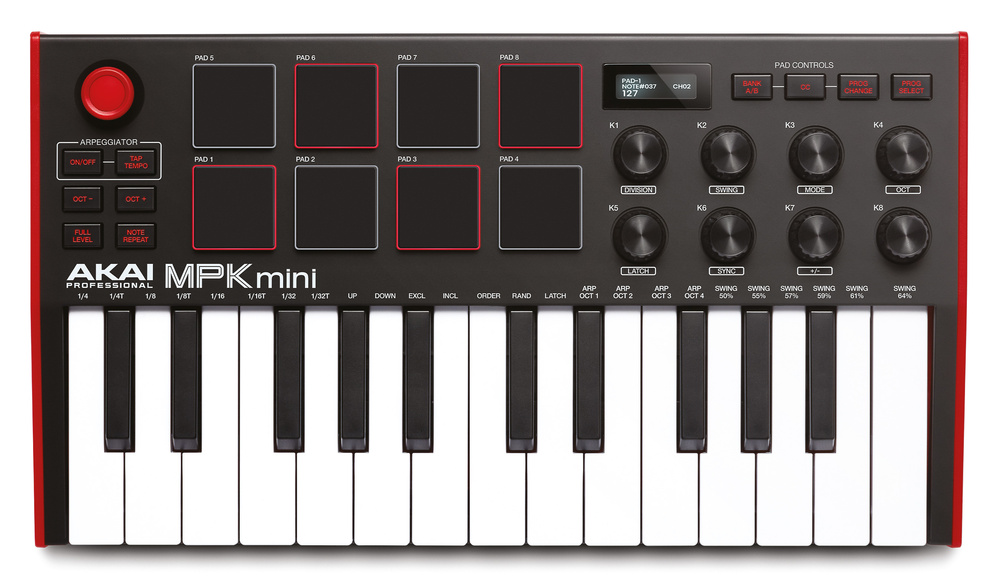
Comprehensive review of the Akai MPK Mini Mark III MIDI keyboard. Detailed analysis of the Gen 2 enhanced keybed, improved drum pads, build quality upgrades, and new OLED display that make this the top budget MIDI controller choice.
Akai MPK Mini Mk3 Review: Is This Still the Best MIDI Keyboard in 2025?
Introduction: Reclaiming the Crown
The Akai MPK Mini Mark III represents the latest evolution of one of the most popular budget MIDI keyboards ever created. As a longtime favorite among bedroom beat makers and professional producers alike, the MPK Mini established itself as the go-to entry-level controller. However, in recent years, the Mark II predecessor developed a reputation as a “jack of all trades, master of none,” with users increasingly exploring alternative options.
Can the Mark III reclaim its position as the industry-standard budget MIDI controller? This comprehensive review examines the improved features and addresses whether this fairly-priced keyboard deserves its place in your studio.
The Gen 2 Enhanced Dynamic Keybed: Addressing the Biggest Complaint
Previous Generation Issues
The Mark II’s keybed represented its most significant weakness. Common complaints included:
- Flimsy, plasticky key feel
- Poor velocity response and accuracy
- Numerous reports of keys physically breaking off
- Limited key travel affecting playability
These issues overshadowed the Mark II’s otherwise solid feature set, pushing many users toward competing products.
Mark III Improvements
Akai’s Gen 2 Enhanced Dynamic Keybed directly addresses every previous complaint. After several weeks of studio use, the improvements are undeniable:
Structural Integrity: Keys feel substantially more sturdy and far less flimsy than the previous generation. The construction inspires confidence that these keys will withstand regular use without the physical failures that plagued the Mark II.
Velocity Sensitivity: The accuracy and responsiveness of velocity detection improved dramatically. The keybed now captures playing dynamics faithfully, translating subtle touch variations into corresponding MIDI data with precision.
Key Travel: Increased key travel distance enhances the overall playing experience significantly. This additional travel provides better tactile feedback and makes expressive playing more natural.
Realistic Expectations
The Mark III features 25 mini keys—not full-sized, not weighted. However, within the mini-key category, this Gen 2 keybed represents a massive improvement over its predecessor. For a portable, budget-friendly controller, the playing experience now matches or exceeds reasonable expectations.
Improved Build Quality: Premium Feel at Budget Price
Material and Construction
The MPK Mini Mark III maintains an almost entirely plastic construction, but the quality of that plastic makes all the difference. This “nice, sturdy, high-grade plastic” feels significantly more substantial than the Mark II without adding excessive weight that would compromise portability.
Weight Balance
Akai achieved an ideal balance—sufficient heft to feel solid and quality-built, yet light enough to maintain the portability that makes the MPK Mini series appealing. The keyboard stays planted during use without feeling cheap or fragile.
Drum Pads: MPC-Style Performance in Compact Form
Building on Strength
Many users argued the Mark II already excelled in drum pad implementation, questioning whether improvements were necessary. Nevertheless, the Mark III pads represent a notable upgrade.
Physical Improvements
Pad Thickness: The Mark III pads feature slightly greater thickness, contributing to improved durability and feel.
Velocity Sensitivity: Already impressive in the Mark II, velocity sensitivity in the Mark III captures even more nuanced dynamics. Finger drumming techniques translate accurately into velocity data, enabling expressive programming.
Pad Banking: The addition of pad bank functionality doubles the available pads from eight to sixteen. This expansion provides greater flexibility for complex drum programming and sample triggering without requiring multiple controller pages.
Performance Characteristics
The pads exhibit slightly more stiffness compared to traditional Akai MPC drum pads found on significantly more expensive devices. While a softer, “squishier” feel might be preferable, this minor compromise seems reasonable given the dramatic price difference. At this price point, no competing keyboards offer comparable MPC-style pads with this level of quality.
Enhanced Rotary Knobs: Endless Encoder Upgrade
Technical Improvement
The transition to endless encoders provides substantially more flexibility when tweaking parameters in software instruments and DAWs. Unlike potentiometers with limited rotation range, endless encoders spin continuously, adapting to whatever parameter range you’re controlling.
Physical Enhancements
Beyond functional improvements, the physical knob quality increased noticeably:
- Larger diameter for easier grip and more precise control
- Improved tactile feel with better resistance and response
- Reduced plasticky sensation compared to Mark II knobs
These refinements make extended mixing and sound design sessions more comfortable and precise.
Omnidirectional Joystick: Love It or Hate It
Akai’s Space-Saving Solution
The four-way joystick returns as Akai’s signature approach to pitch bend and modulation—combining both functions into a single, compact control. While admittedly somewhat gimmicky, this joystick works reliably and saves valuable surface real estate on the compact controller.
For users familiar with traditional pitch and mod wheels, the joystick requires minimal adjustment. It performs its function adequately, even if it lacks the premium feel of dedicated wheels on higher-priced keyboards.
Arpeggiator: Best-in-Class at This Price Point
The MPK Mini’s arpeggiator feature continues to stand out as one of the most capable options available in budget MIDI keyboards. The Mark III maintains this tradition with:
- Extensive flexibility in pattern creation
- Deep customization options for rhythm and note order
- Intuitive control via dedicated buttons and parameter knobs
This feature alone can inspire creative ideas and enhance production workflow, justifying the keyboard’s value.
Note Repeat: Essential for Drum Programming
The note repeat function proves invaluable when programming drums, particularly for rapid hi-hat patterns and rolls. This feature, accessible via dedicated button, allows instant rhythmic repetition of any note or pad, dramatically speeding up beat creation.
Connectivity: Modern with One Omission
Available Connections
- USB connection for DAW integration and MIDI communication
- Sustain pedal input jack for expressive keyboard playing
Notable Omission
The absence of MIDI output functionality represents a minor disappointment. Competing products like the Novation Launchkey Mini include this feature, enabling control of hardware synthesizers and drum machines. While not essential for many users, MIDI output would have enhanced the Mark III’s versatility for those working with external gear.
OLED Display: Useful Addition or Gimmick?
Display Functionality
The small OLED screen provides real-time visual feedback for:
- Note velocity values
- CC (Continuous Controller) parameter data
- Current control assignments
- Arpeggiator settings
Practical Value Assessment
The display generates strong opinions. Proponents appreciate having immediate visual confirmation of controller activity. Skeptics note that computer screens located nearby already display identical information.
Personal assessment: The OLED represents a nice bonus feature rather than a compelling reason to purchase. It provides convenient at-a-glance information, but doesn’t fundamentally change the user experience. Consider it pleasant added value rather than essential functionality.
Included Software Bundle
Bundled Applications
The Mark III includes several software instruments:
- Mini Grand – piano sounds
- Velvet – electric piano tones
- Hybrid 3 – versatile synthesizer
- MPC Beats – beat-making software
MPC Beats Highlight
MPC Beats deserves special mention as legitimate production software modeled after Akai’s legendary MPC workflow. While available as a free download to anyone, its inclusion adds value for newcomers unfamiliar with Akai’s ecosystem. The software provides genuine beat-making capability suitable for creating professional-quality productions.
Value Proposition: Unbeatable at The Price Point
Feature-to-Price Ratio
At a fair price, the MPK Mini Mark III delivers exceptional value:
- Significantly improved 25-key mini keybed
- Eight velocity-sensitive MPC-style drum pads with banking (16 total)
- Eight endless encoder knobs
- Professional arpeggiator
- Note repeat functionality
- OLED display
- Compact, portable form factor
- Included software bundle
This feature set at this price point proves difficult to match, positioning the Mark III as the benchmark against which competing budget controllers must be measured.
Target User Profile
The Mark III excels for:
- Beginners seeking quality first MIDI keyboard
- Beat makers requiring excellent drum pads
- Traveling producers needing portable control
- Budget-conscious musicians maximizing value
- Students learning music production
- Supplementary controller for existing setups
Comparison Context: How Does It Stack Up?
While this review focuses on the Mark III itself, potential buyers should consider alternatives like the Arturia MiniLab series, Novation Launchkey Mini, and Native Instruments Komplete Kontrol M32. Each offers different feature trade-offs, but the MPK Mini’s combination of drum pad quality, improved keybed, and aggressive pricing makes it highly competitive.
Conclusion: Reclaiming the Title
The Akai MPK Mini Mark III successfully addresses the critical weaknesses that plagued its predecessor while maintaining the features that made the series popular. The dramatically improved Gen 2 keybed eliminates the primary complaint about the Mark II, while enhanced build quality, upgraded pads and knobs, and added features like the OLED display demonstrate Akai’s commitment to product evolution.
Does the Mark III reclaim its position as the best-selling, industry-standard budget MIDI controller? The answer is yes. At the price, this keyboard delivers professional-grade features in a compact, portable package without significant compromises. The improvements over the Mark II aren’t incremental—they’re substantial enough to warrant upgrade consideration for existing Mark II owners and make the Mark III the default recommendation for anyone seeking an affordable, capable MIDI keyboard.
For producers, beat makers, and musicians seeking maximum value without sacrificing essential features, the Akai MPK Mini Mark III represents the strongest option in its price category.
Related posts:
 Arturia MiniLab 3 vs. Akai MPK Mini Mk3: Expert Comparison of the Best Entry-Level MIDI Keyboards
 Akai MPK Mini Plus vs. MPK Mini Play vs. MPK Mini Mk3: Complete Comparison Guide
 Jamstik Studio vs. Jammy MIDI Guitar: Complete Comparison Guide to Choosing Your Perfect MIDI Guitar
 Jamstik Studio MIDI Guitar Review: The Ultimate All-in-One Solution for Guitarists and Producers
 Akai Professional APC64 Review: Next-Generation Ableton Live Controller
 Arturia KeyStep Pro Review: Building the Ultimate Hybrid MIDI Controller Setup for Modern Production
 Jamstik MFC1 MIDI Floor Controller Review: Three Game-Changing Ways This Controller Transformed My Studio
 Akai Force Standalone Sampler/Sequencer Review: The Ultimate Performance Workstation