

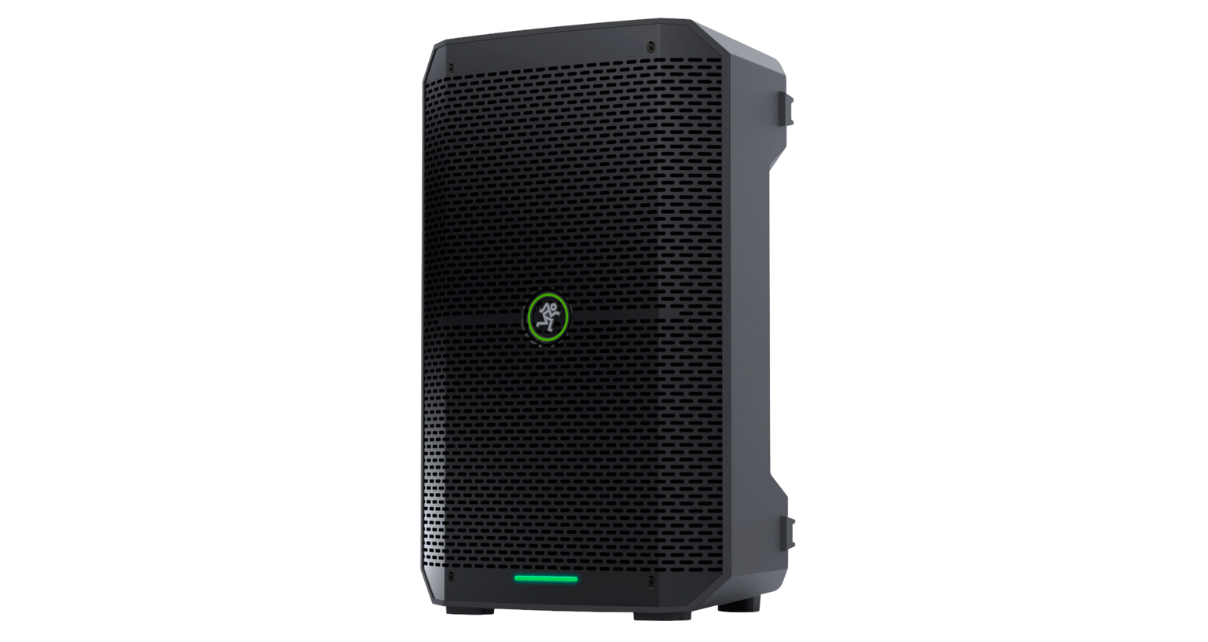
The Mackie Thump Go combines battery power, Bluetooth, and professional wired connectivity in one speaker—perfect for DJ practice, parties, and portable use.
Mackie Thump Go Review: The All-In-One DJ Speaker Solution
One Speaker System for Every DJ Scenario
Finding speakers that excel at multiple roles is challenging—studio monitors can’t handle parties, portable Bluetooth speakers suffer from latency, and PA speakers aren’t practical for home use. The Mackie Thump Go attempts to solve this puzzle by being a legitimate three-in-one solution: home practice monitor, portable Bluetooth speaker, and party PA, all in a single compact package.
Design and Versatility
The Thump Go is deceptively compact. At first glance, it appears modestly sized, but the robust construction and well-engineered driver configuration deliver output levels that belie its dimensions. The classic wedge-shaped enclosure allows multiple positioning options—standing upright, lying on its side, or angled in the traditional floor monitor wedge position.
A heavy-duty metal grille protects the driver while a molded handle on top makes carrying comfortable. The overall build quality feels professional—this is designed for regular transport and use, not delicate studio placement.
The removable battery system is brilliantly implemented. Accessible via two screws on the bottom panel, the battery pack slides out for replacement or to swap in a freshly charged unit. This hot-swap capability means you can extend runtime indefinitely with spare batteries—critical for all-day events or situations where AC power isn’t available.
When powered from mains electricity, the battery charges automatically while the speaker operates. This means your battery is always topped up and ready for portable use, eliminating the planning required with many battery-powered speakers.
The speaker can be pole-mounted using the standard socket on the bottom, making it suitable for professional installations or elevated placement at events.
Audio Performance
The Thump Go sounds impressive for its size. The frequency response is well-balanced with surprising low-end extension. While you won’t confuse it with a dedicated subwoofer system, the bass is tight and impactful enough for most DJ applications short of large club environments.
The midrange is clear and present, ensuring vocals and melodic elements cut through without harshness. Highs are crisp without being fatiguing—important for extended listening sessions during practice or production work.
Volume capability is the real standout. These speakers get genuinely loud. Push them hard and they maintain composure, with onboard limiting preventing damage from overdriving. You can comfortably fill small to medium spaces or provide personal monitoring at serious volumes without distortion.
The stated 12-hour battery life is optimistic—real-world use at DJ-appropriate volumes yields closer to 6 hours. However, this is still more than adequate for most portable applications, and the removable battery addresses longer requirements.
Connectivity and Mixing
The back panel reveals comprehensive connectivity. Two combo XLR/TRS inputs accept microphones or line-level sources. Input one switches between mic and instrument levels, while input two offers similar flexibility. An eighth-inch stereo auxiliary input provides convenient connection for DJ controllers or mobile devices.
The onboard mixing section includes independent level controls for each input plus a master volume. This basic mixing capability means you can balance your DJ mix against a microphone for announcements without external mixers.
Phantom power is available for condenser microphones, powered by the internal battery system when operating wirelessly or from AC power when connected to mains. This makes the Thump Go surprisingly capable for simple PA applications with microphones.
A through output on XLR sends a mixed signal to additional speakers or a subwoofer, making it easy to expand the system. For DJ applications, you might run your controller into a small subwoofer, then send signal from the sub to one or two Thump Go speakers for full-range coverage.
Voicing Modes
Mackie includes several preset EQ curves called “voicing modes” accessible via a selector on the back panel. The Music mode provides balanced frequency response suitable for DJ monitoring. Speech mode optimizes for microphone intelligibility. Monitor mode adjusts response for floor wedge positioning.
An Outdoor mode compensates for the bass loss typical when using speakers outdoors. This is particularly clever—outdoor sound is notoriously bass-deficient, and having a preset that addresses this saves endless EQ tweaking.
Music Ducking mode automatically reduces music volume when it detects microphone input—useful for announcements or MC work where you want the music to drop automatically when someone speaks.
A feedback eliminator helps prevent microphone squeal, and you can even disable the front LED light ring if you prefer subtler aesthetics.
Bluetooth Functionality
The Bluetooth connection works exactly as expected for casual listening or background music. Pairing is simple, range is adequate, and sound quality is respectable for compressed Bluetooth audio.
However, for DJ use, Bluetooth introduces unacceptable latency. This isn’t a Thump Go limitation—it’s inherent to Bluetooth technology. For DJ applications, always use wired connections to ensure zero latency between your actions and audio output.
The Bluetooth stereo pairing feature allows two Thump Go speakers to link wirelessly for stereo operation. Again, this is great for casual listening but inappropriate for DJ use due to latency.
The App
An optional app provides additional control and configuration beyond the physical controls. You can access EQ customization, manage settings, and link multiple speakers.
The app feels somewhat unnecessary for basic DJ use—the physical controls cover essential functions. However, for more complex multi-speaker setups or detailed EQ tweaking, the app provides convenient remote access.
The app doesn’t suffer from the feature-bloat that plagues some speaker apps. It’s straightforward and focused on useful functions rather than gimmicks.
Practical DJ Scenarios
For home practice, a pair of Thump Go speakers provides excellent monitoring. Position them on your desk or stands, connect your controller’s outputs, and you have a proper stereo setup with enough power to practice at realistic volumes without shortcomings becoming apparent.
For mobile events, the battery operation and self-contained nature make setup trivial. Charge them beforehand, carry them to the venue, connect your gear, and perform. No AC outlets required, minimal cables, maximum flexibility.
The ability to add a microphone input directly means you don’t need a separate mixer for announcements or simple MC duties. This reduces the equipment count for basic mobile gigs substantially.
As a casual Bluetooth speaker for beach days, park hangs, or casual listening, a single Thump Go provides excellent sound quality and ridiculous runtime compared to typical portable speakers.
Limitations
While versatile, the Thump Go makes compromises to achieve its multiple-role capability. Dedicated studio monitors in the same class will provide more accurate frequency response and detail retrieval. The focus here is volume and versatility rather than analytical precision.
For larger venues or outdoor events, you’ll want more firepower. The Thump Go works well for gatherings up to perhaps 50-75 people outdoors or small indoor parties, but beyond that, larger PA systems become necessary.
The battery adds weight—these aren’t the lightest speakers in their size class. The trade-off seems fair given the runtime and hot-swap capability, but portability enthusiasts should note they’re not featherweights.
Value Proposition
The Thump Go occupies an interesting pricing position. It costs more than budget Bluetooth speakers but less than professional PA speakers or quality studio monitors. For DJs who need speakers that genuinely handle multiple roles, this pricing makes sense—you’re replacing several specialized speakers with one versatile solution.
The build quality and Mackie’s reputation suggest longevity. These should provide years of reliable service across various applications, making the per-use cost quite reasonable.
Who Should Buy
Hobby DJs without dedicated practice spaces will find the Thump Go ideal—loud enough for proper practice, small enough for apartments, and portable enough to easily move or take elsewhere.
Mobile DJs working smaller events can build a complete system around two Thump Go speakers and potentially a compact subwoofer, creating a setup light enough to transport easily yet capable enough for professional use.
Anyone wanting truly versatile speakers that actually work well for multiple purposes rather than being mediocre at everything should consider the Thump Go. It genuinely succeeds at being good enough at DJ monitoring, good enough for parties, and good enough for casual portable use that most users won’t need specialized alternatives.
Final Verdict
The Mackie Thump Go successfully delivers on its three-in-one premise. Rather than compromising to the point of mediocrity, it provides genuinely capable performance in each of its intended roles.
The sound quality is impressive for the size, the battery life is practical, and the connectivity options cover real-world DJ needs. The ability to swap batteries extends usefulness into scenarios where fixed-battery speakers would run dry.
Build quality inspires confidence that these will survive regular use and transport. The professional feature set—pole mounting, proper mixing inputs, phantom power—demonstrates this is a legitimate tool rather than a consumer product with delusions of adequacy.
For DJs who want one speaker system that handles practice, parties, and portable use without compromising seriously in any role, the Mackie Thump Go succeeds admirably. It’s not the absolute best at any single application, but its combination of competence across multiple uses makes it uniquely valuable for DJs whose needs don’t fit into neat categories.
Related posts:
 Marshall Middleton Review: Can You DJ with This Retro Bluetooth Speaker?
 AIAIAI Unit-4 Wireless Speaker Review: The Ultimate Portable Studio Monitor for DJs and Producers
 WAVE EIGHT Speaker Review: Wireless Freedom, DJ-Ready Sound—But Not Perfect
 Tribit StormBox Bluetooth Speaker Review: Portable Powerhouse for Mobile DJs and Outdoor Performance
 JBL DJ Speaker Lineup Review: Real-World Solutions For Every Gig
 Minirig 3 Subwoofer Review: The Ultimate Portable DJ Speaker System Made By DJs, For DJs
 Hercules DJControl Mix Ultra Review: The Portable Wireless DJ Solution
 HK Audio Move 8 Review: Portable PA Speaker Built for DJs on the Move